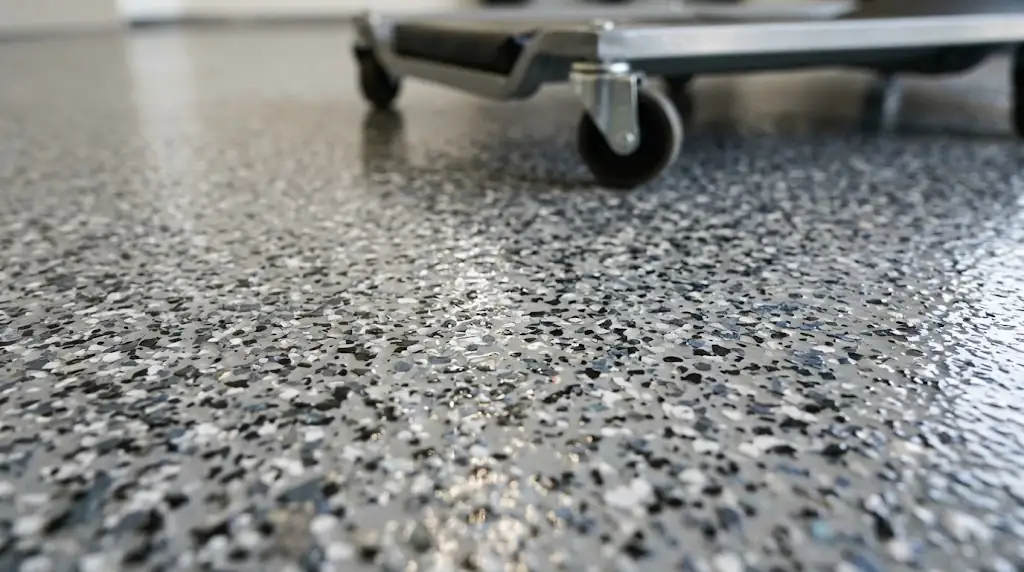
DIY epoxy kits fail in North Texas because they use low-solids, water-based paints that cure to a paper-thin film incapable of withstanding hot tire temperatures, while relying on chemical acid etching that fails to mechanically bond to the concrete. In Collin County, extreme summer surface temperatures and hydrostatic moisture pressure from expansive clay soils quickly cause thin DIY coatings to blister, peel, and delaminate within 12 to 24 months.
Big-box store kits are packaged for convenience, not commercial longevity. They contain high percentages of water or solvent thinners that evaporate during curing, leaving behind a fragile plastic film. Professional installations rely on 100% solids industrial resins, mechanical diamond profiling, and specialized moisture barriers engineered to withstand harsh North Texas conditions.
DIY Kits vs. Professional Floor Systems: Technical Breakdown
The difference between a store-bought epoxy paint kit and a professional installation is fundamentally chemical and mechanical.
| Performance Metric | Box-Store DIY Kits | Professional Multi-Layer System | The Engineering Difference |
| Resin Formulation | Water-based or solvent-based | 100% solids epoxy + aliphatic polyaspartic | Water evaporates; 100% solids cures at full applied volume. |
| Dry Film Thickness (DFT) | 1 to 3 mils (0.001″–0.003″) | 20 to 35+ mils (0.020″–0.035″) | Professional floors are over 10 times thicker. |
| Surface Preparation | Muriatic acid or citric wash | Heavy planetary diamond grinding | Diamond tooling cuts open pores; acid smooths them over. |
| Concrete Surface Profile | CSP 0 to CSP 1 (Too slick) | CSP 2 to CSP 3 (Rough mechanical teeth) | Meets ICRI mechanical bonding standards. |
| Adhesion Pull-Off Strength | 50 to 150 PSI | 400 to 600+ PSI (Concrete fails first) | Exceeds ASTM D4541 pull-off testing standards. |
| Hot-Tire Heat Resistance | Softens at 120°F to 140°F | Immune beyond 300°F | Professional polyaspartic resists blazing vehicle tires. |
| Moisture Mitigation | None (Traps water) | Dedicated moisture vapor barrier (MVB) | Withstands up to 20 lbs of hydrostatic ground pressure. |
| Functional Lifespan | 1 to 2 Years | 20+ Years | DIY requires constant re-application; pro is permanent. |
The Four Primary Reasons DIY Kits Fail in Collin County
1. Acid Etching Is an Ineffective Surface Preparation Method
Store-bought kits instruct homeowners to scrub the slab with a mild packet of citric acid or dilute muriatic acid. In theory, acid neutralizes the surface and opens pores. In practice, acid etching fails in North Texas for several reasons:
- Pore Glazing: Acid reacts with the calcium carbonate in the concrete, creating a chemical sludge that settles back into the capillaries if not flushed with pressurized equipment.
- Moisture Saturation: Acid etching requires soaking the slab with hundreds of gallons of water. Concrete acts like a sponge. Trapping that moisture inside the slab guarantees that the new epoxy layer blisters as water vapor attempts to escape.
- Surface Hardness: Modern residential garages in cities like Frisco and Prosper feature machine-troweled, high-strength concrete. Acid cannot penetrate this dense, polished surface. Only commercial floor grinders equipped with 20- to 30-grit industrial diamond tooling can tear off the smooth laitance and create the rough texture required for permanent mechanical adhesion.
2. Water Evaporation Leaves a Paper-Thin Coating
DIY kits typically consist of 30% to 50% solids. The remaining 50% to 70% of the gallon is water or solvent.
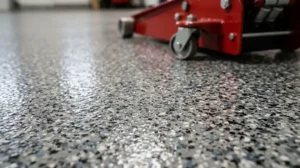
When applied with a standard paint roller, the wet film may look adequate. However, as the coating cures, the water and solvents evaporate into the air. The resulting dry film thickness shrinks down to an insubstantial 1 to 2 mils—roughly the thickness of a single sheet of office paper. In contrast, a professional 100% solids epoxy base coat topped with a full vinyl broadcast and polyaspartic clear coat builds to 25 to 35 mils. A 2-mil coating offers zero impact resistance against dropped tools, jacks, or rolling tool chests.
3. Texas Summer Heat Causes Immediate Hot-Tire Pickup
During North Texas summers, ambient temperatures consistently reach triple digits. Concrete garage slabs absorb radiant heat, while vehicle tires reach operating temperatures between 140°F and 175°F after highway driving.
When a vehicle parks on a DIY water-based coating, the heat from the tires re-softens the low-grade synthetic resin. As the vehicle sits, the cooling tire contracts, creates a vacuum effect, and grips the softened floor paint. When the car pulls out the following morning, the tires rip large rectangles of coating clean off the concrete. Professional systems prevent hot-tire pickup by utilizing aliphatic polyaspartic topcoats that retain total structural integrity at temperatures exceeding 300°F.
4. Expansive Clay Soils Create High Hydrostatic Pressure
The North Texas region rests on expansive Blackland Prairie clay. When heavy spring rains fall, the clay soil absorbs immense volumes of water and expands. This soil expansion creates hydrostatic pressure, forcing moisture vapor up through the porous concrete foundation slab.
DIY kits do not include a moisture vapor barrier. When ground moisture migrates to the surface, it hits the underside of the non-breathable DIY paint. Hydrostatic pressure builds until it breaks the weak bond, pushing the paint upward into large fluid-filled blisters that pop and peel away in jagged sheets.
Local Failure Realities Across Our Service Areas
Subdivisions across North Texas exhibit unique slab conditions that overwhelm DIY materials:
- Frisco and Celina: Newer home developments often feature high-PSI, smooth-troweled slabs with curing compounds applied by the original builders. DIY acid cannot break down these sealers, resulting in immediate peel-off within weeks of application.
- McKinney and Plano: Older concrete foundations possess decades of deep automotive oil, grease, and transmission fluid absorption. DIY degreasers only wash the surface. Heavy diamond grinding is required to physically grind away oil-soaked concrete aggregate before applying resin.
- Prosper and Allen: Post-tension residential slabs flex subtly under shifting clay soils. Brittle DIY paints crack instantly across moving micro-joints, whereas industrial-grade systems integrate flexible polyurea joint fillers to bridge movement.
- Little Elm: Elevated water tables near Lake Lewisville mean high sub-slab moisture vapor emissions. Applying a low-cost DIY paint without an industrial moisture barrier guarantees vapor delamination during humid seasons.
The Real Cost of a Failed DIY Project
Homeowners turn to DIY kits to save money, spending between $400 and $800 on materials, rollers, and acid. However, when the floor fails, the cost to fix it far exceeds the cost of hiring a professional from the start.
THE TRUE DIY REPLACEMENT TIMELINE:
Initial DIY Material & Tool Purchases:      $400 – $800
Failed Floor Lifespan:                      12 to 24 Months
Contractor Grinding / Stripping Surcharge:  $1.50 – $3.00 per sq. ft.
Professional Re-Installation:               $5.50 – $8.50 per sq. ft.
----------------------------------------------------------------------
Total Out-of-Pocket Expense:                $3,500 – $5,500+
Professional contractors cannot install high-performance epoxy over a peeling DIY floor. The failed coating must be completely stripped. Grinding off failed, gummy DIY paint clogs commercial diamond tooling and adds hundreds of dollars in mechanical prep fees to the final invoice.
Attempting to coat a garage floor with a big-box DIY kit in the North Texas climate is a losing investment. Protect your garage foundation with a diamond-ground, commercial-grade hybrid epoxy and polyaspartic system engineered to withstand intense heat, abrasive clay, and heavy automotive use. For an honest evaluation of your concrete and a transparent, upfront quote, connect with Frisco Epoxy Flooring. Visit our contact page today to schedule your on-site estimate.