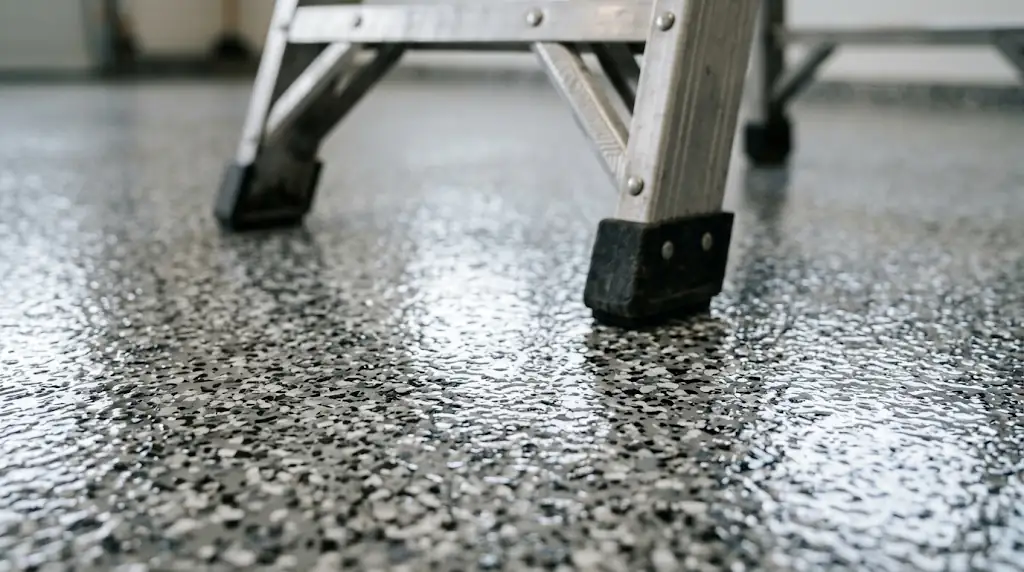
Polyaspartic is superior to traditional epoxy as a topcoat in Collin County due to its complete UV stability, rapid cure profile, and a 300°F heat tolerance that eliminates hot-tire pickup during brutal North Texas summers. However, a hybrid system combining an industrial epoxy base coat with a polyaspartic topcoat outperforms a 100% pure polyaspartic installation by providing deeper concrete pore penetration and mandatory hydrostatic moisture mitigation.
Choosing between polyaspartic and traditional epoxy is not an either-or decision. Modern industrial coating engineering leverages both chemistries simultaneously. Understanding the mechanical strengths and vulnerabilities of each resin reveals why single-chemistry systems routinely fail in North Texas garages.
Head-to-Head Technical Comparison
Resin performance depends on tensile strength, thermal limits, chemical composition, and molecular elongation.
| Performance Metric | Traditional 100% Solids Epoxy | Aliphatic Polyaspartic | The North Texas Advantage |
| UV Stability | Poor (Aromatic; turns amber/yellow) | 100% Immune (Aliphatic polymer) | Polyaspartic prevents fading from Texas sunlight. |
| Hot-Tire Resistance | Moderate (Softens at 140°F–160°F) | Extreme (Withstands heat > 300°F) | Polyaspartic stops tire pickup during 100°F+ summers. |
| Abrasion Resistance | Moderate (Taber test: 40–50 mg loss) | Exceptional (Taber test: 15–20 mg loss) | Polyaspartic resists scratches from tracked-in clay grit. |
| Concrete Penetration | Deep (Slow open time allows wicking) | Shallow (Fast cure gels on surface) | Epoxy creates a stronger mechanical root system in slab. |
| Flexibility / Elongation | 2% to 8% (Rigid, brittle) | 25% to 100% (High elasticity) | Polyaspartic bridges micro-cracks from shifting soil. |
| Working Time (Pot Life) | 30 to 45 Minutes | 15 to 20 Minutes | Epoxy allows thorough hand-tool work during application. |
| Full Return to Service | 72 Hours to 7 Days | 24 to 48 Hours | Polyaspartic allows vehicles back inside within 2 days. |
Abrasion metrics evaluated according to testing standards established in ASTM D4060.
Where Polyaspartic Wins: Topcoat Performance
Polyaspartic is an advanced aliphatic polyurea coating. It solves the three primary operational failures common to traditional epoxy garage floors in Collin County.
- Total UV Immunity: Traditional epoxies are aromatic compounds. Sunlight breaks their chemical bonds, turning clear and light-gray finishes into a chalky, sickly yellow within months. Polyaspartic is an aliphatic polymer. It is chemically immune to ultraviolet radiation. West-facing garages and outdoor aprons in Frisco and Plano retain optical clarity permanently under continuous sun exposure.
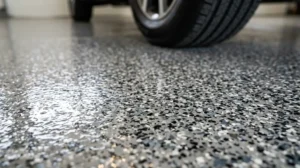
- Immunity to Hot-Tire Pickup: Summer concrete in Collin County regularly hits 110°F to 125°F. Car tires pull into garages at temperatures exceeding 160°F. Traditional epoxy softens at these temperatures, fusing to hot tire rubber and peeling off the slab as the vehicle cools. Polyaspartic retains complete structural rigidity beyond 300°F.
- Superior Abrasion Resistance: Collin County soil is loaded with abrasive quartz and caliche dust. Standard epoxy scratches easily under foot and vehicle traffic, quickly turning cloudy in vehicle tire lanes. Polyaspartic cures to an ultra-dense molecular matrix that is up to four times more scratch-resistant than standard epoxy.
Where Epoxy Wins: Slab Adhesion and Moisture Defense
Despite the topcoat advantages of polyaspartic, marketing claims promoting “100% polyaspartic direct-to-concrete” systems are misleading in North Texas. Traditional 100% solids epoxy remains the superior base coat on raw concrete.
- Capillary Wicking: Epoxy possesses a longer open time and low molecular surface tension. When rolled across diamond-ground concrete, it cures slowly over several hours. This extended window allows the liquid resin to flow deep into the open capillaries and pores of the concrete slab, creating an unbreakable mechanical anchor.
- Moisture Vapor Pressure: North Texas sits over expansive Blackland Prairie clay. Heavy seasonal rains saturate the subsoil, creating high hydrostatic pressure that forces ground moisture up through the garage foundation. Specialized moisture-mitigating epoxy primers resist up to 20 pounds of moisture vapor pressure per 1,000 square feet.
- The Flaw of Direct-to-Slab Polyaspartic: Polyaspartic cures extremely fast—often within 20 to 30 minutes. When applied directly to bare concrete, the resin gels before it can penetrate the slab. It forms a thin, surface-level shell. When hydrostatic pressure builds beneath the garage floor, direct-to-slab polyaspartic systems pop off the concrete in wide, clean sheets.
The True Industry Benchmark: The Hybrid System
To achieve maximum longevity in Collin County, professional contractors install a hybrid resin system. This approach combines the structural adhesion of epoxy with the surface armor of polyaspartic:
- Mechanical Diamond Grinding: Opens the concrete surface profile (CSP 2 to CSP 3) to prepare the concrete pores.
- Epoxy Moisture Barrier Base: A 100% solids, moisture-mitigating epoxy base coat is flooded across the slab to penetrate deep into the substrate and block ground vapor.
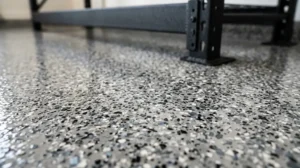
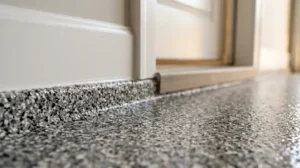
- Full Flake Broadcast: Vinyl color flakes are broadcast to total rejection into the wet epoxy bed, building impact thickness and tensile strength.
- Aliphatic Polyaspartic Topcoat: After scraping excess flake, a clear polyaspartic topcoat seals the matrix, providing UV resistance, chemical defense, and complete hot-tire immunity.
Application Demands Across Collin County Service Areas
Structural demands vary depending on municipal construction eras, topography, and local soil conditions across our service footprint:
- Prosper, Celina, and Frisco: Subdivisions with active, expanding foundations built over rich agricultural clay. These homes demand the moisture-blocking power of a slow-cure epoxy base to combat sub-slab groundwater migration, topped with polyaspartic to resist intense summer sun exposure.
- Plano and McKinney: Established homes featuring garage slabs with 20 to 40 years of engine oil exposure. Epoxy base coats are mandatory to penetrate deep past prior oil remediation, while a clear polyaspartic seal repels tree tannins, brake fluids, and lawn equipment chemicals.
- Allen and Little Elm: High humidity near Lake Lewisville and Lake Lavon causes elevated surface moisture condensation. Pure polyaspartic base coats struggle to adhere to damp-curing concrete, making moisture-tolerant epoxy primers essential before applying clear protective topcoats.
Final Cost and Value Assessment
A traditional all-epoxy installation costs less upfront, running between $5.50 and $7.00 per square foot. However, standard epoxy requires re-coating or professional polishing every three to five years to combat yellowing and tire wear.
A hybrid system utilizing an epoxy base coat with a commercial polyaspartic topcoat costs between $6.50 and $9.50 per square foot. It eliminates premature failure modes, provides a functional lifespan exceeding 20 years, and delivers the lowest total cost of ownership.
Never settle for a fragile, single-resin floor system that cannot handle the soil movement and summer heat of North Texas. Get a commercial-grade hybrid system engineered to last a lifetime. For a technical analysis of your concrete and an honest, transparent estimate, partner with Frisco Epoxy Flooring. Head to our contact page today to book your on-site evaluation and lock in your installation date.